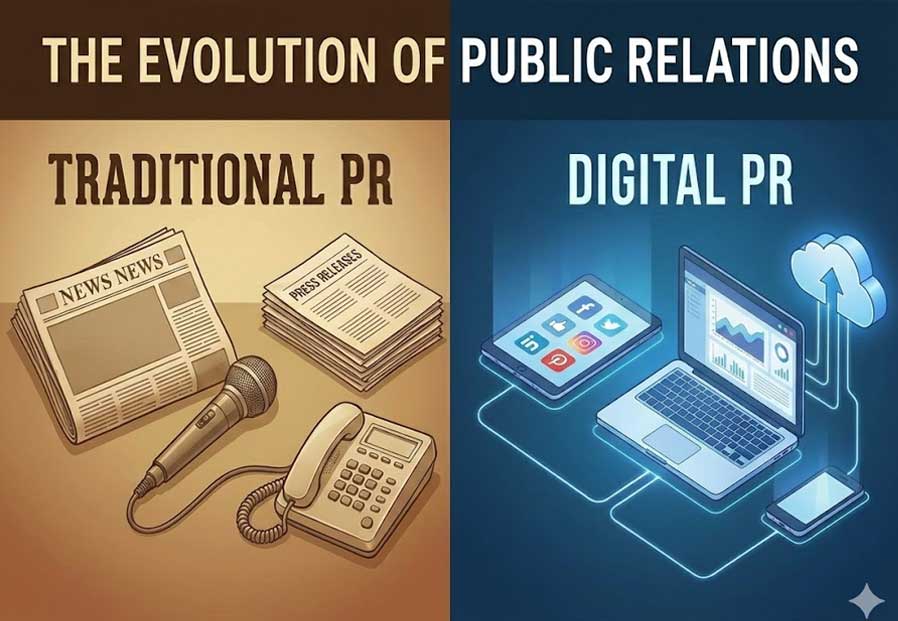


Public Relations has evolved significantly over the years. While traditional PR laid the foundation for media relations and reputation management, digital PR has emerged as a powerful extension shaped by the internet, social media, and online news consumption. Understanding the difference between digital PR and traditional PR helps organizations choose the right strategy—or the right mix—for effective communication.
Traditional PR focuses on conventional media channels and offline communication methods. It emphasizes credibility through established media platforms and long-standing journalistic practices.
Traditional PR is especially effective for reaching mass audiences and building long-term brand credibility through trusted media outlets.
Digital PR uses online platforms and digital tools to manage reputation, increase visibility, and engage audiences in real time. It aligns closely with how people consume news and information today.
Digital PR focuses on immediacy, interaction, and measurable outcomes.


Traditional PR relies on print, television, and radio, while digital PR operates through websites, social media, search engines, and online publications.
Digital PR allows instant dissemination and global reach. Traditional PR typically follows fixed publication or broadcast schedules, making it slower but often more authoritative.
Traditional PR is largely one-way communication. Digital PR enables two-way interaction through comments, shares, and direct feedback
Digital PR offers detailed performance metrics such as impressions, clicks, engagement, and conversions. Traditional PR measurement relies more on circulation figures and estimated reach.
Traditional PR focuses on written stories and interviews. Digital PR supports multimedia formats including videos, infographics, reels, and interactive content.
In regions with strong traditional media consumption, traditional PR remains highly relevant
Digital PR is particularly effective for startups, technology companies, and brands targeting younger audiences.


In reality, digital PR and traditional PR are not opposing forces. The most effective communication strategies integrate both.
For example:
An integrated approach maximizes reach, credibility, and engagement.
The choice between digital PR and traditional PR depends on:
Organizations often benefit most from a balanced PR strategy that leverages the strengths of both.
Digital PR and traditional PR serve different but complementary roles in modern communication. Traditional PR builds trust and authority, while digital PR drives speed, engagement, and visibility.
In today’s media environment, success lies not in choosing one over the other, but in strategically combining both to tell compelling stories, manage reputation, and connect meaningfully with audiences.